
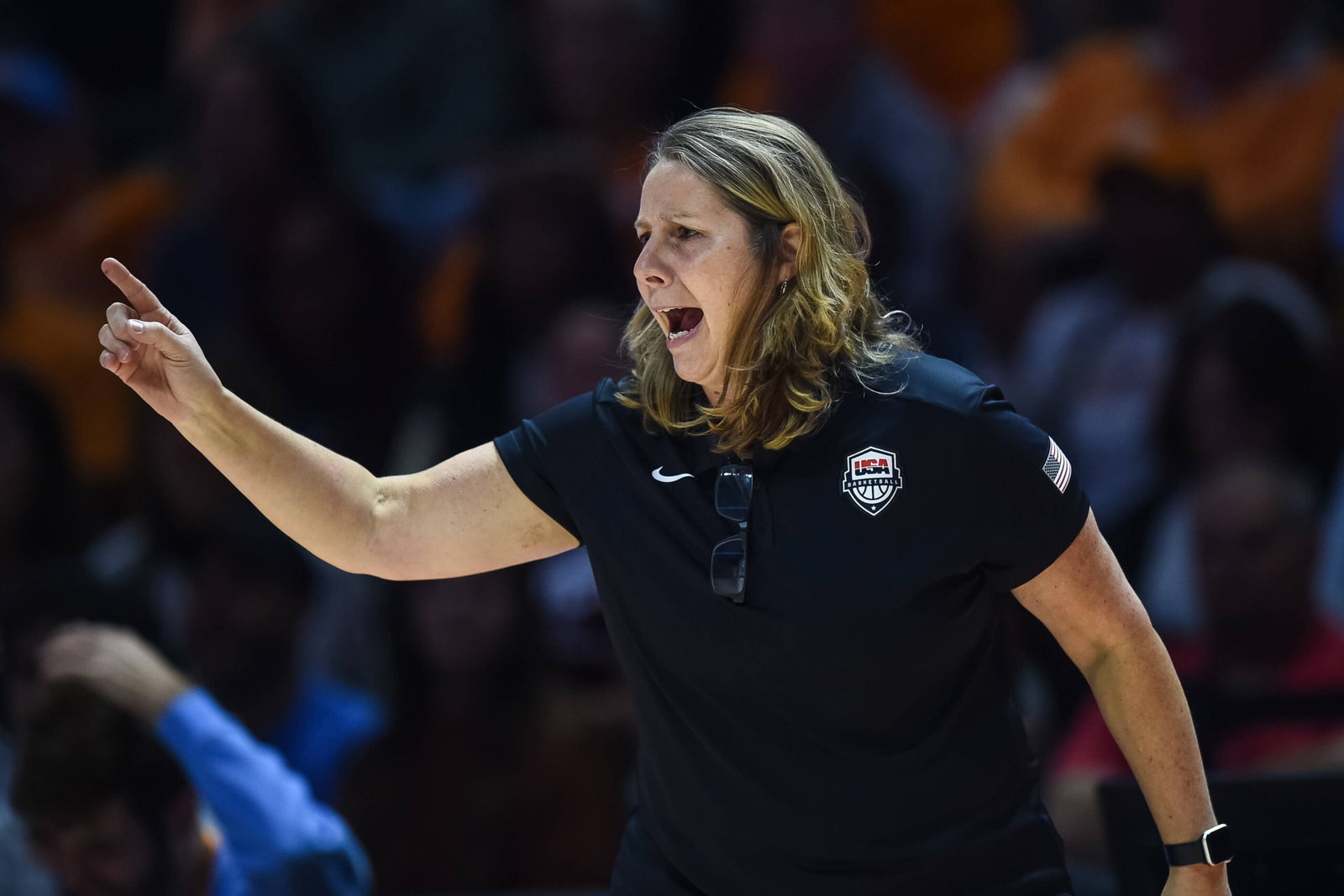
KNOXVILLE, TN - NOVEMBER 05: USA Basketball Women s national team, Nationalteam head coach Cheryl Reeve coaches during an exhibition game between the Tennessee Lady Vols and the USA Basketball Women s National Team on November 5, 2023, in Thompson-Boling Arena at Food City Center, in Knoxville, TN. Photo by Bryan Lynn/Icon Sportswire COLLEGE BASKETBALL: NOV 05 Women s - USA Women s National Team at Tennessee EDITORIAL USE ONLY Icon20231105007
KNOXVILLE, TN - NOVEMBER 05: USA Basketball Women s national team, Nationalteam head coach Cheryl Reeve coaches during an exhibition game between the Tennessee Lady Vols and the USA Basketball Women s National Team on November 5, 2023, in Thompson-Boling Arena at Food City Center, in Knoxville, TN. Photo by Bryan Lynn/Icon Sportswire COLLEGE BASKETBALL: NOV 05 Women s - USA Women s National Team at Tennessee EDITORIAL USE ONLY Icon20231105007
Cheryl Reeve is sounding the alarm on a new era of WNBA officiating. Following the Minnesota Lynx’s narrow 91-90 loss to the Atlanta Dream, the veteran coach aimed at a 42-foul outburst that she claims punishes marginal contact.
In a clip shared by Andrew Dukowitz on X, Reeve explained that while she expected stricter officiating after offseason discussions about player safety and excessive contact, she did not expect routine contact to be called so tightly.
“I mean, you watch the preseason games, you watch the games yesterday, you watch the games today. What I’m confused about, being on the task force, we talked about unnecessary physicality; we didn’t say we want to call marginal fouls. We never brought that up," she said.
She added that, "It takes a little bit of time for sure to calibrate, both them and us… I mean, sometimes a marginal foul happens. Watching the NBA, I don’t know what a foul is in the NBA. You clobber something, and it’s nothing, and then there’s marginal contact, and it is a foul.”
For context, foul calls have sharply increased across the WNBA to begin the new season.
The Minnesota Lynx were called for 24 fouls against the Atlanta Dream’s 18, while some preseason games saw even higher numbers, including 61 combined fouls in a matchup between the Seattle Storm and New York Liberty.
The stricter officiating comes after the WNBA introduced tougher rules and significantly higher fines under the new 2026 CBA to reduce excessive physical play and technical fouls.
According to a Front Office Sports report, the WNBA has significantly increased fines under the new rules. Technical fouls now start at $500 instead of $200 from last season, while repeated technicals can rise to $1,500 and even lead to a suspension.
Flagrant fouls now also cost players $500 each, and the league has introduced new fines for flopping that increase after repeated violations.
At the same time, several players and coaches, including Stephanie White, Caitlin Clark, and Brittney Sykes, have already received technical fouls for arguing with referees.
So, with tensions rising and foul penalties getting more expensive early in the season, many around the league, including Cheryl Reeve, believe better officiating could help calm things down.
It was always going to be a slow process to fundamentally change the long-standing physical culture in the WNBA.
Cheryl Reeve Sounds Alarm as WNBA’s Physical Style Faces Major Shift
Last season, Cheryl Reeve's Minnesota Lynx established themselves as one of the top defensive teams in the league, which included the Atlanta Dream and Golden State Valkyries, who used physical play to defend against opponents.
That approach became especially effective against smaller teams like the Indiana Fever and Washington Mystics.
“We didn’t handle their physicality. That’s going to be the M.O. against us all year long,” head coach Stephanie White said after the Fever’s loss to the Dream. “Teams are going to be physical. That’s how I’d play us.”
Later in the season, the Valkyries used a similar strategy against Caitlin Clark, holding her to just 11 points on 3-of-14 shooting while she missed all seven of her three-point attempts.
“I mean, you guys saw what we’re doing. We were being disruptive. We know she doesn’t like physicality,” Valkyries coach Natalie Nakase said.
With referees making tighter contact calls, teams built around physical defense may have to adjust quickly. But that change will not happen overnight.
A lack of training time before the season has contributed to the league's high foul rate.
Strict enforcement is already forcing teams to pivot from on-ball pressure to double-team schemes.
The WNBA needs to decide whether physical defense should remain part of its identity or whether it should adopt this new direction. What are your thoughts? Tell us in the comments.
Read more at She Got Game!
Written by

Sauramita Debbarma
Edited by

Utsav Gupta